
Freelance Embedded C++ Programmer STM32, Texas Instruments, Nordic & Arduino
Looking for a Senior Freelance C++ Programmer for embedded systems and industrial microcontroller architectures? I help hardware startups, tech enterprises, and R&D labs engineer deterministic bare-metal and RTOS firmware using Modern C++ (C++17/C++20) with zero memory leaks, ultra-low power consumption, and production-grade reliability.




Industrial Microcontrollers Fully Supported
Modern ISO C++ firmware architectures tailored for leading industrial silicon families worldwide.
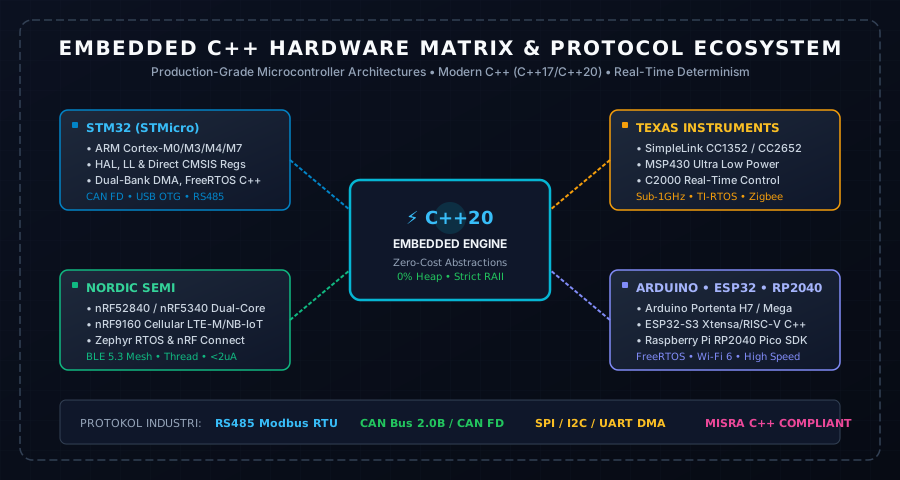
STM32 (STMicroelectronics)
ARM Cortex-M0/M3/M4/M7 architecture. Modern bare-metal development using Low-Layer (LL) and CMSIS registers encapsulated within C++ RAII classes. DMA circular ring buffers for SPI, I2C, UART, and CAN FD without MCU core clock penalties.
Texas Instruments SimpleLink
Specializing in TI SimpleLink CC1352/CC2652 multiprotocol RF (Sub-1GHz & 2.4GHz), MSP430 ultra-low-power MCUs, and C2000 real-time DSP controllers. Non-blocking state machines with TI-RTOS/FreeRTOS for long-range industrial telemetry up to dozens of kilometers.
Nordic Semiconductor (nRF)
Engineering for nRF52840, nRF5340 dual-core, and nRF9160 cellular IoT (LTE-M/NB-IoT). Event-driven architectures built on Zephyr RTOS and nRF Connect SDK with deep sleep current < 2µA, ideal for wearables and coin-cell powered wireless sensors.
Arduino, ESP32 & RP2040
Production-grade transformation of prototype Arduino sketches into hardened commercial firmware. Industrial boards such as Arduino Portenta H7, ESP32-S3 dual-core with native ESP-IDF C++, and Raspberry Pi RP2040 with Pico C++ SDK for high-throughput computing at competitive bill of materials (BOM).
Why Choose Modern C++ for Embedded Firmware?
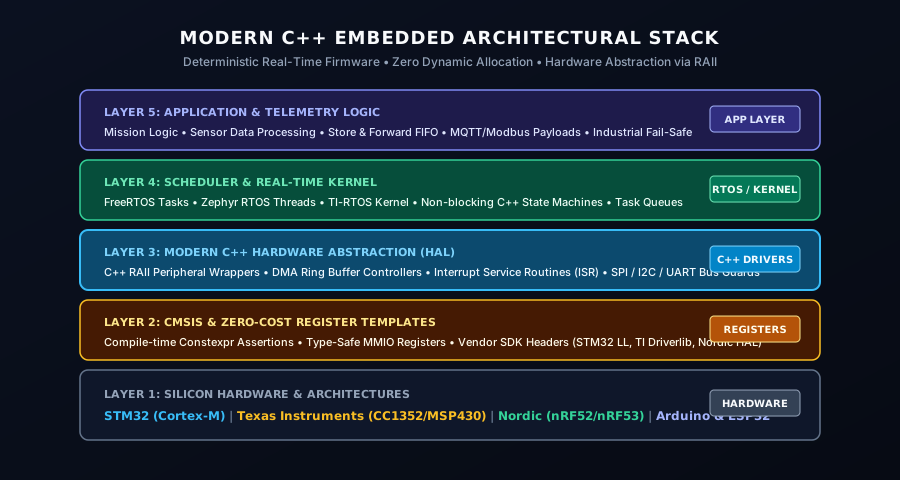
Leaving fragile legacy procedural C behind. We implement C++17/C++20 with absolute memory determinism.
1. Zero-Cost Abstractions
Template classes, constexpr assertions, and aggressive inlining guarantee that object-oriented encapsulation compiles down to assembly instructions as tight and fast as hand-tuned C, with zero runtime penalty.
2. Zero Dynamic Heap Allocation
Calling malloc() or new is the primary root cause of MCU crashes caused by RAM heap fragmentation. We strictly enforce static allocation, fixed-size circular buffers, and placement-new for 24/7 industrial uptime.
3. RAII for Hardware Peripherals
Resource Acquisition Is Initialization (RAII) guarantees hardware peripherals such as SPI Chip-Select lines, I2C bus mutexes, and sensor power rails are automatically claimed and safely released upon scope exit, preventing deadlocked buses.
4. Multi-Threading & RTOS Safety
Deep integration with FreeRTOS and Zephyr RTOS leveraging C++ message queues, atomic variables, and critical section guards to ensure inter-thread and inter-core communication is completely immune to race conditions.
Hardware-in-the-Loop (HIL) & Rigorous Testbench
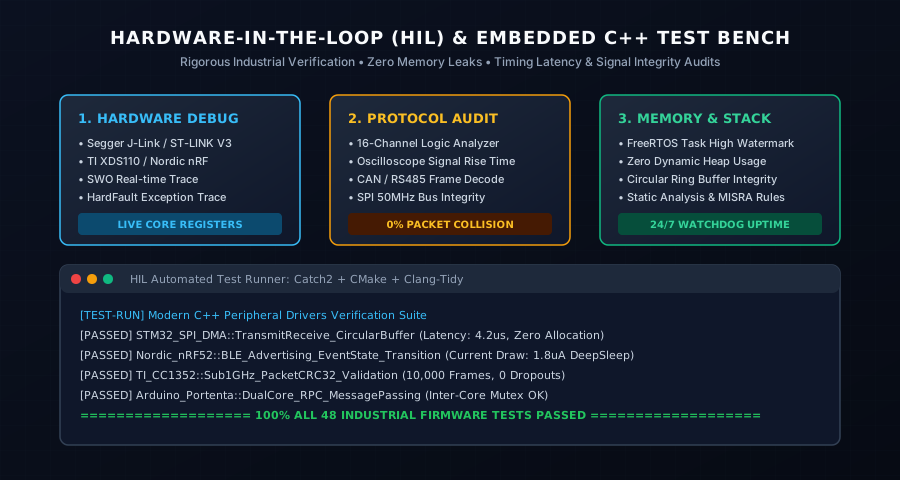
Every line of code is validated on physical silicon using high-precision lab instruments to verify clocks, bus timings, noise, and signal integrity.
End-to-End Engineering Portfolio
Seamless integration spanning PCB schematics, microcontroller firmware, industrial telemetry gateways, and native desktop C++ GUIs.
Firmware & Embedded Systems →
Layanan rekayasa firmware bare-metal dan RTOS untuk hobby, riset, dan instrumen komersial.
Hardware & PCB Layout →
Perancangan skematik dan layout PCB multilayer (KiCad/Altium) siap produksi massal tanpa mapping error.
Industrial IoT & Telemetri Edge →
Solusi gateway Modbus RS485 to MQTT, isolasi optocoupler 2.5kV, dan cloud SCADA dashboard.
Qt C++ CMake Desktop →
Aplikasi GUI desktop berkinerja tinggi 60 FPS untuk HMI industri, visualisasi telemetri, dan kontrol instrumen.
Frequently Asked Questions (FAQ)
In-depth answers regarding embedded C++ architecture, code guarantees, NDA protocols, and remote contractor arrangements.
Is Modern C++ (C++17/C++20) safe and efficient for memory-constrained microcontrollers?
Yes, absolutely. When implemented following correct embedded guidelines, Modern C++ is as lean as C and far safer. Under the Zero-Cost Abstractions doctrine, modern features such as constexpr, template metaprogramming, enum class, and RAII are evaluated entirely at compile-time with zero runtime footprint. We strictly eliminate dynamic allocations (malloc/new) in favor of static ring buffers and compile-time fixed structures.
Which microcontroller families and architectures are supported?
Comprehensive support covers STMicroelectronics STM32 (ARM Cortex-M0/M3/M4/M7/H7), Texas Instruments SimpleLink (CC1352, CC2652, MSP430, C2000), Nordic Semiconductor (nRF52840, nRF5340, nRF9160), industrial Arduino (Portenta H7, Nano Every), Espressif ESP32-S3/C3 (native ESP-IDF C++), and Raspberry Pi RP2040.
Do you have deep production experience integrating RTOS kernels?
Yes. I regularly architect and maintain firmware running on FreeRTOS, Zephyr RTOS, and TI-RTOS with modern C++ abstractions (OOP task lifecycle wrappers, queue guards, recursive mutexes, and binary semaphores). This delivers deterministic preemption, non-blocking asynchronous state machines, and verified deadlock avoidance.
What are your contract models and availability for freelance or remote engagements?
Two flexible models are supported: 1) Milestone-Based Fixed Price for projects with concrete deliverables, and 2) Dedicated Monthly Remote Contractor for technical teams in Indonesia, Singapore, the US, or Europe with 3-4 hours of daily timezone overlap. B2B invoices and international transfers via Wise or SWIFT wire are supported.
Does the client own 100% of the intellectual property, source code, and schematics?
Yes, 100%. All intellectual property rights, full Git repositories with complete atomic commit histories, circuit schematics, CMake build scripts, and architecture design documents are transferred irrevocably to the client upon milestone sign-off.
How is physical hardware debugging handled in a remote work model?
I operate a fully equipped hardware laboratory featuring a dedicated Hardware-in-the-Loop (HIL) testbench, 16-channel logic analyzers, digital storage oscilloscopes, high-resolution current profilers for nanoampere deep-sleep verification, and Segger J-Link Ultra+ / ST-LINK V3 debuggers. Clients simply ship prototype PCBA boards, or I fabricate dedicated testing fixtures in-house.
Ready to Build Deterministic, Hardened C++ Firmware?
Discuss your microcontroller silicon roadmap, communication protocol specifications, or milestone sprint schedules directly with me.